AI agents are moving beyond simple question-and-answer chatbots.
Modern platforms can qualify prospects, update customer records, route conversations, analyze business data, and complete tasks across connected systems. Businesses often pair these automation tools with other AI-powered solutions, such as a logo maker, to quickly establish a professional brand identity before scaling customer engagement and operations.
The best AI agent solution depends on the job you need it to perform. Some platforms focus on customer conversations, while others support voice calls, analytics, workflow execution, or the data infrastructure agents need to work reliably.
This guide compares 11 AI agent solutions and closely related automation platforms for 2026, starting with two tools built around customer engagement and then moving into voice, messaging, data, analytics, and operational workflows.
The Best AI Agent Solutions for 2026 at a Glance
|
AI agent solution
|
Best for
|
Main use case
|
|
SleekFlow
|
Conversational sales teams
|
Omnichannel sales and customer engagement
|
|
Emergent
|
Founders and operators building custom AI agents
|
Custom AI agents built and deployed from a plain-English description
|
|
Respond.io
|
High-volume, mid-market B2C businesses where conversations drive revenue
|
Customer conversation platform with AI Agents for qualification, routing and lifecycle execution across messaging and voice
|
|
CloudTalk
|
Sales and support teams with high call volumes
|
AI-powered inbound and outbound calling
|
|
360 CTI AI Voice Agent
|
Salesforce-based sales and support teams
|
AI calling, lead qualification and call handoff
|
|
360 SMS App
|
Salesforce and Zoho teams
|
AI-powered multichannel messaging and follow-up automation
|
|
360 InstantDocs
|
Salesforce teams automating document-heavy workflows
|
Document generation from live CRM data
|
|
Airbyte Agents
|
Developers and data teams building production agents
|
Business data access and context for AI agents
|
|
Kommunicate
|
Customer support teams
|
AI-first support automation with human handoff
|
|
Amplitude
|
Product and growth teams
|
AI-powered product analytics and autonomous analysis
|
|
Chatbase
|
Customer experience teams running support, sales, and product guidance agents
|
AI agents that resolve issues, drive revenue, and deploy across chat, email, and voice
|
|
monday.com
|
Operations and cross-functional teams
|
AI agents inside work management workflows
|
What Is an AI Agent Solution?
An AI agent solution is software that can interpret a goal, decide what steps to take, and perform actions with limited human involvement.
Unlike a traditional chatbot, an AI agent does not only return a prepared answer. Depending on the platform and its integrations, it may collect customer information, retrieve account data, update a CRM, schedule an appointment, analyze a dataset, or hand a conversation to the right employee.
The distinction matters because many products use the term “AI agent” for different capabilities. A useful evaluation should examine what the software can actually do after it understands a request.
Some tools in this guide are complete agent platforms. Others solve a narrower part of the agent workflow, such as giving agents reliable access to company data or automating a specialist process inside Salesforce.
How We Selected the Best AI Agent Solutions
The platforms included in this guide are assessed according to several practical factors:
- The business processes the agent can handle
- The channels and systems it can connect with
- The level of control available to human teams
- The ease of configuring and testing the agent
- Its ability to take actions rather than merely generate text
- The clarity of its intended use case
There is no single platform that will fit every company. A sales team working mainly through WhatsApp will have different requirements from a product team analyzing behavioral data or an operations team automating work across multiple systems.
Brand experience also matters. Before deploying an agent, businesses should define how it should sound, when it should escalate a request, and which actions it may complete. Resources covering AI branding trends and AI tools for marketing can help teams connect automation with a consistent customer experience.
1. SleekFlow
Best for: Businesses using conversational commerce to generate and convert leads
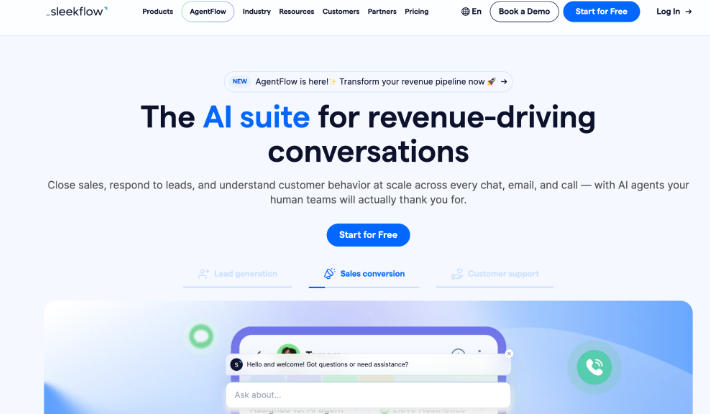
SleekFlow is an omnichannel customer engagement platform with an AI agent product called AgentFlow. It is designed for businesses that sell and support customers through messaging channels.
AgentFlow can assist with lead qualification, product enquiries, customer support and other conversation-driven workflows. Teams can configure an agent with their own knowledge sources, playbook instructions, customer data access, and actions, then test it before deployment.
The platform connects customer conversations with business data and workflows. SleekFlow also supports commerce and CRM integrations, helping agents use customer context rather than treating every conversation as an isolated chat.
Key SleekFlow features
- AI agents for sales, support, and customer engagement
- Messaging across channels such as WhatsApp, Instagram, and Facebook
- Knowledge bases, approved web sources, and live web search
- Lead scoring and customer-data access
- Configurable playbooks, response behavior, and exit conditions
- Human handover when a conversation needs personal attention
- Testing, batch testing, and optimization tools before deployment
SleekFlow lets teams test responses in a playground before making an agent available to customers. Its setup tools also help businesses control which information the agent can use and how it should behave in different situations.
Who should consider SleekFlow?
SleekFlow may suit retail, e-commerce, and service businesses that receive a large share of their inquiries through messaging applications.
It is especially relevant when the goal is to connect conversational selling with customer data. A business could use an agent to answer an initial product question, learn what the customer needs, and send the conversation to a salesperson when buying intent becomes clear.
2. Emergent
Best for: Founders, operators, and agencies that want a custom AI agent built around their own workflow, without writing code
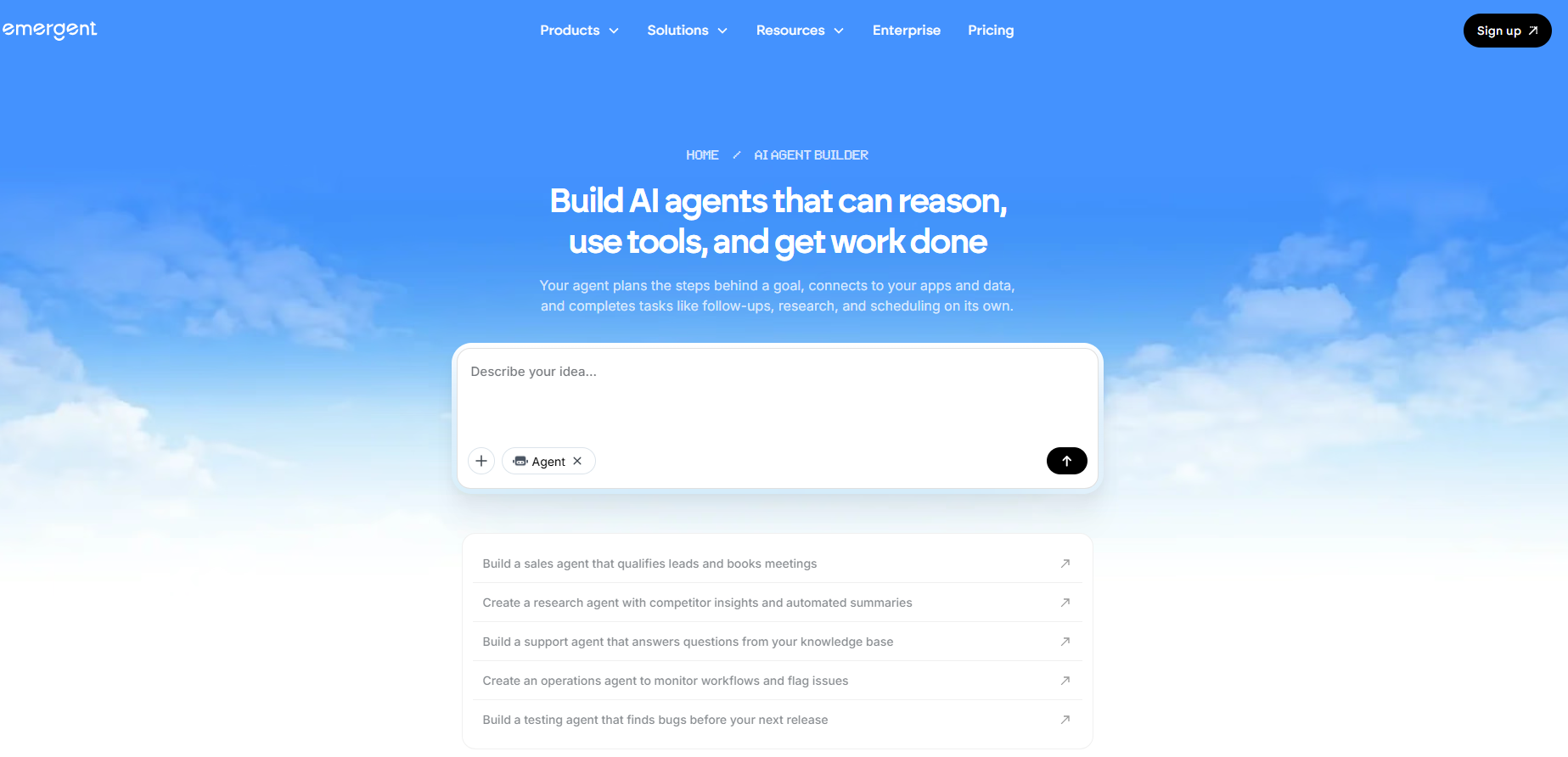
Emergent is an AI agent builder that turns a plain-English description into a working, deployable AI agent. Instead of configuring a fixed agent template, you describe what the agent should do, and Emergent builds the agent along with the interface, backend, and integrations it needs to run.
That makes it a different kind of option on this list. Most tools here add agents inside an existing product, like a phone system, inbox, or CRM. Emergent builds the agent as its own piece of software, shaped around how your business already runs.
Changes happen through conversation too. You can ask it to adjust the agent's tone, add product knowledge, or set limits on what the agent should not discuss.
Key Emergent features
- Builds custom AI agents from a natural-language description
- Multi-agent architecture that handles the agent's logic, backend, database, and deployment
- One Universal Key for GPT, Claude, and Gemini models, with no separate API accounts
- Vision and image generation support for multimodal agents
- Integrations with Stripe, Twilio, SendGrid, Google OAuth, Shopify, and more
- Custom knowledge, personality, and guardrails set through chat
- One-click deployment to your own custom domain
- Full code ownership with export and GitHub integration
Who should consider Emergent?
Respond.io is best suited to mid-market B2C businesses in sectors such as e-commerce, retail, automotive, education, healthcare, real estate, hospitality, and travel. It is especially relevant when customer conversations arrive through several messaging, social and voice channels, and their volume has outgrown lightweight inboxes or disconnected channel-specific tools.
Emergent suits businesses whose needs don't fit a packaged agent: a support assistant trained on your own policies, an internal agent that summarizes documents, or a customer-facing agent connected to payments and messaging. It is built for non-technical founders, SMB operators, and agencies who can describe the job but don't want to code it.
Teams that only need a ready-made agent inside a platform they already use, such as their CRM or phone system, may find a native option on this list a quicker fit.
3. Respond.io
Best for: High-volume, mid-market B2C businesses where customer conversations directly influence revenue
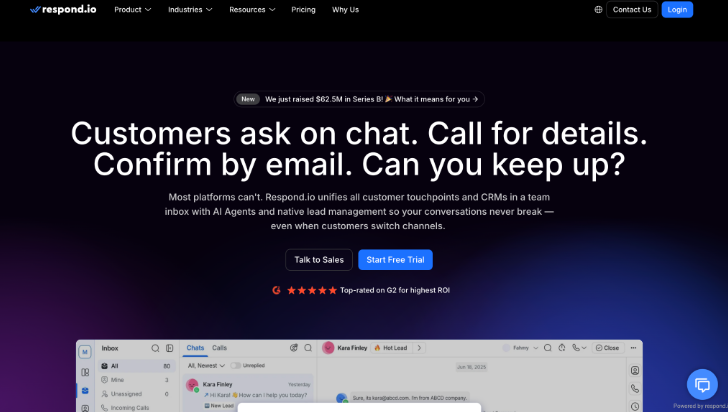
Respond.io is a customer conversation platform for high-volume, mid-market B2C businesses where conversations drive revenue. It unifies chats, calls and emails from channels such as WhatsApp, Instagram, Messenger, TikTok and voice in one workspace, maintaining customer context as people move between touchpoints.
Its AI Agents do more than answer customer questions. They can qualify leads, collect information, update lifecycle stages, trigger follow-ups, route conversations according to intent and escalate high-value opportunities to human teams with the relevant context already attached.
Rather than adding another disconnected messaging tool, respond.io acts as an operational layer for customer conversations. It connects AI Agents, human teams, automation, and customer data so businesses can move more inquiries towards appointments, purchases and repeat revenue. Its enterprise-grade infrastructure includes 99.999% uptime, helping teams manage revenue-critical conversations reliably at scale.
A 7-day free trial is available.
Key Respond.io features
- Autonomous AI Agents for qualification, routing, follow-ups and lifecycle updates
- Visual workflow builder for custom conversation automation
- True omnichannel inbox for chats, calls and emails
- Voice AI Agents for 24/7 inbound call handling
- Customer lifecycle tracking from first inquiry to payment and repeat purchase
- Native HubSpot and Salesforce integrations, plus Zapier, Make and n8n connectivity
- Reporting across conversations, lifecycle conversions, teams and locations
- Human escalation with conversation history and customer context
- 99.999% uptime and 24/7 human and AI support
Who should consider Respond.io?
Respond.io is best suited to mid-market B2C businesses in sectors such as e-commerce, retail, automotive, education, healthcare, real estate, hospitality, and travel. It is especially relevant when customer conversations arrive through several messaging, social and voice channels, and their volume has outgrown lightweight inboxes or disconnected channel-specific tools.
4. Ringover
Best for: Sales and support teams that want AI-powered calling, live coaching, and CRM connectivity in one platform
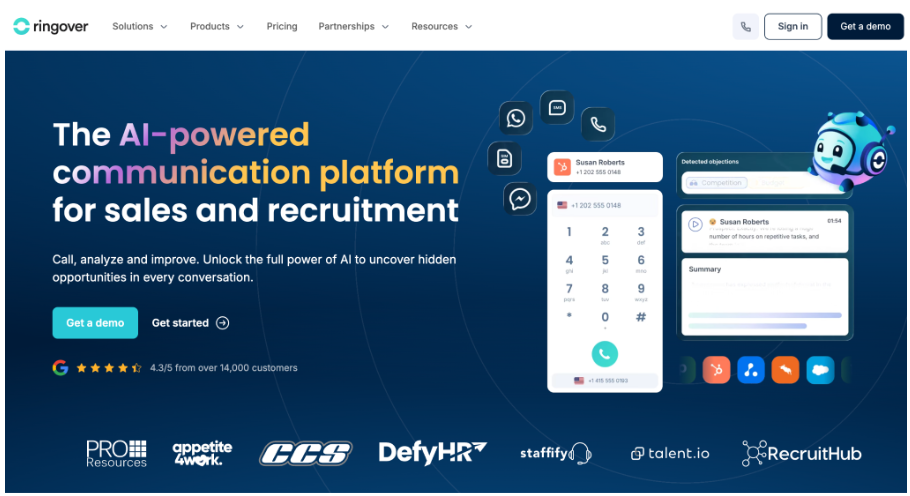
Ringover is a cloud-based VoIP platform built for sales and support teams. It combines unlimited international calling, AI conversation tools, live coaching features, and 100+ CRM integrations in one environment, so teams do not need a separate phone system, coaching tool, and analytics stack.
Its AI layer covers call transcription, voicemail transcription, and call summaries on every plan. Teams that need deeper analysis including conversation intelligence, sentiment analysis, topic detection, and coaching scorecards can add Empower on top of their existing plan. A separate AI Voice Agent (Airo) is also available for automating inbound call handling around the clock.
Ringover also connects with tools such as HubSpot, Salesforce, Pipedrive, Zendesk, and Bullhorn through native integrations, with a click-to-call browser extension that lets representatives dial directly from any web page or CRM interface.
Key Ringover features
- Unlimited international calling to numerous destinations
- AI call transcription, voicemail transcription, and call summaries on all plans
- Call whispering and double listening for real-time coaching
- Real-time dashboards and advanced analytics
- 100+ native integrations including HubSpot, Salesforce, Pipedrive, and Zendesk
- AI Voice Agent (Airo) for automated inbound call handling
- Empower add-on for conversation intelligence and sentiment analysis
- Omnichannel messaging add-on for WhatsApp, Instagram, Facebook Messenger, and email
- 7-day free trial available
Who should consider Ringover?
Ringover is a strong fit for sales, support, and recruiting teams with high call volumes. It is particularly useful for businesses that want coaching tools and CRM integrations built into the same platform as their phone system, rather than managing separate tools for each.
5. CloudTalk
Best for: Businesses that want AI voice agents built into the same platform as their human calling team
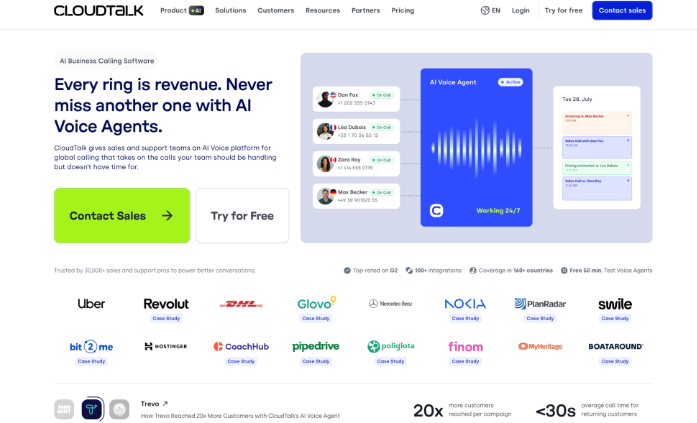
CloudTalk is an AI-powered business calling platform for sales and support teams. Its VoiceAgents can handle inbound and outbound conversations, allowing companies to automate repetitive calls without building a separate telephony and AI stack.
An inbound VoiceAgent can answer common questions, collect structured information, route callers, and book appointments. Outbound agents can be triggered through systems such as CRMs, APIs, and automation tools for follow-ups, reminders, surveys, or lead outreach.
Because VoiceAgents sit inside CloudTalk’s wider calling environment, AI and human calls can use the same phone infrastructure, routing, and operational setup rather than functioning as completely separate systems.
Key CloudTalk features
- AI VoiceAgents for inbound and outbound calls
- Appointment booking and structured information collection
- Human call transfer and routing
- Knowledge-base support for common questions
- API tools that let VoiceAgents take real-time actions
- CRM data export and workflow integrations
- Shared calling infrastructure for AI and human teams
Who should consider CloudTalk?
CloudTalk is a strong fit for sales and support teams where phone volume is high enough that missed calls, repetitive outreach, or after-hours coverage create a real operational problem.
It is particularly useful for companies that already rely heavily on business calling and want to add AI without replacing the entire phone environment around their human representatives.
6. 360 CTI AI Voice Agent
Best for: Sales and support teams that cannot staff round-the-clock phone coverage inside Salesforce
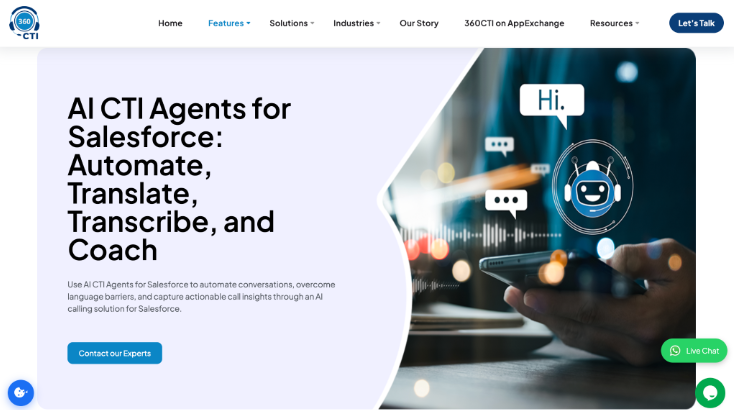
360 CTI’s AI Voice Agent is a Salesforce-focused calling agent designed to automate parts of inbound and outbound phone workflows. It can handle initial conversations, qualify leads, answer common questions, and route calls without requiring a human representative to manage every interaction from the start.
The wider 360 CTI platform combines calling with Salesforce context, call automation, and AI-assisted analysis. Outcomes can be logged into the CRM, while features such as transcription, sentiment analysis, and AI-generated call information help teams keep customer records current.
When a conversation needs human judgment, the call can be handed over rather than forcing the customer to restart the process from the beginning.
Key 360 CTI AI Voice Agent features
- AI handling for inbound and outbound calls
- Lead qualification and automated call routing
- Salesforce-based call workflows and CRM context
- Automatic call outcomes and AI-assisted summaries
- Real-time transcription and sentiment analysis
- Multilingual and call-translation capabilities
- Human handoff for conversations that need a representative
Who should consider 360 CTI AI Voice Agent?
360 CTI may suit sales and support teams running high call volumes inside Salesforce, especially when after-hours coverage, multiple time zones or manual dialing limit how many customers and prospects the team can reach.
7. 360 SMS App
Best for: Salesforce and Zoho teams that want AI-powered customer messaging without moving conversations into a separate platform
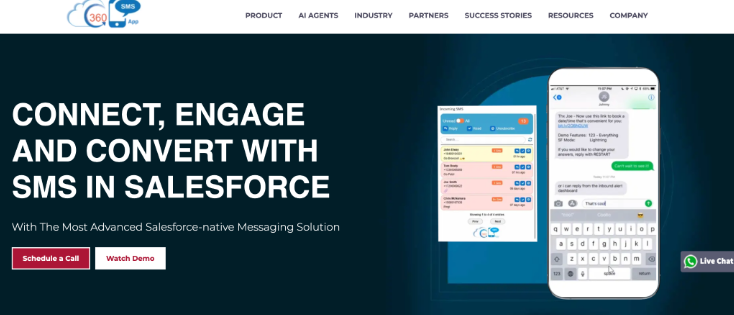
360 SMS App is a CRM-native digital engagement platform for messaging, automation, and AI-assisted customer conversations. It is designed to let teams manage channels such as SMS and WhatsApp while keeping conversation activity connected to Salesforce or Zoho records.
The platform can support automated follow-ups, multichannel sequences, AI chatbots, and agent-triggered messaging. In Salesforce environments, it can also work with Agentforce, so defined CRM conditions or agent actions trigger messages without waiting for a representative to notice a record manually.
Its AI features extend beyond message generation into areas such as suggested replies, template analysis, conversation support, and compliance monitoring.
Key 360 SMS App features
- CRM-native messaging for Salesforce and Zoho
- SMS, WhatsApp and other messaging channels
- AI chatbots and automated customer conversations
- Agentforce-triggered messaging workflows in Salesforce
- AI-assisted replies and message refinement
- Drip campaigns, reminders and follow-up automation
- Consent, opt-out and compliance controls
- Conversation activity written back to CRM records
Who should consider 360 SMS App?
360 SMS App is most relevant to organizations that already run customer communication through Salesforce or Zoho and want messaging automation to stay connected to CRM data.
It may be especially useful for sales, service, and operations teams that lose opportunities because follow-ups happen late or depend too heavily on representatives remembering the next step.
8. 360 InstantDocs
Best for: Salesforce teams still building contracts, invoices, proposals, and other repeat documents by hand
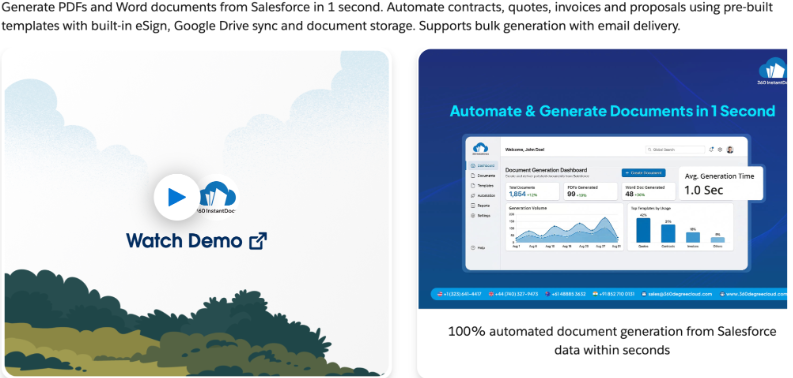
360 InstantDocs is a Salesforce-native document generation tool that turns live CRM data into finished Word or PDF files. It is not a general-purpose conversational AI agent in the same sense as many other products in this guide. Instead, it automates a specialist workflow that can sit inside a broader agent-assisted or Salesforce automation process.
Templates are created in Microsoft Word and connected to Salesforce fields. Teams can use merge fields, conditional logic and related-record data without rebuilding every document manually. Documents can then be generated from individual records or at scale through list views, reports and automated Salesforce workflows.
The result is a narrower product than an autonomous agent platform, but a practical option where document creation is one of the repetitive tasks slowing a Salesforce workflow down.
Key 360 InstantDocs features
- One-click document generation from Salesforce records
- Microsoft Word-based template creation
- Live merge fields and conditional document logic
- Word and PDF output
- Bulk generation from list views and reports
- Salesforce Flow support for automated generation
- Generated files stored back in Salesforce Files
Who should consider 360 InstantDocs?
360 InstantDocs fits sales, legal, HR, finance and operations teams producing repeat documents from Salesforce data.
It is particularly useful where employees still copy names, dates, values or contract details from CRM records into static templates by hand.
9. Airbyte Agents
Best for: Developers and data teams building production AI agents that need reliable access to business data across many systems
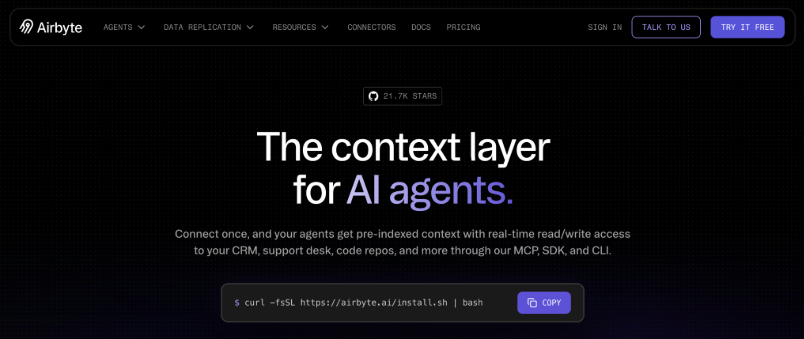
Airbyte Agents is a data and context layer for AI agents. Rather than acting as an end-user chatbot, it gives agents a structured way to discover, query and act on business information spread across CRMs, support platforms, databases and SaaS applications.
A central part of the product is the Context Store, which replicates selected business entities into a managed, searchable layer. Agents can search that indexed context first instead of crawling several source APIs every time they need an answer.
When an agent needs fresh information or has to take an action, Airbyte’s agent connectors provide real-time reads and writes back to connected systems.
Key Airbyte Agents features
- Searchable Context Store for business data
- Real-time reads, writes and actions through agent connectors
- Managed authentication for connected systems
- Access through MCP, Python SDK, HTTP API and web interfaces
- Cross-system context for CRM, support, billing and operational data
- Framework-agnostic infrastructure for custom agents
- Logging and visibility into agent actions
Who should consider Airbyte Agents?
Airbyte Agents is aimed primarily at developers, AI product teams and data engineers building agents that need dependable business context.
It is a strong fit when an agent has to answer questions or complete tasks across several systems and direct runtime API orchestration is becoming slow, expensive or difficult to maintain.
10. Kommunicate
Best for: Mid-market teams that need AI-powered customer support with a clean handoff to human agents
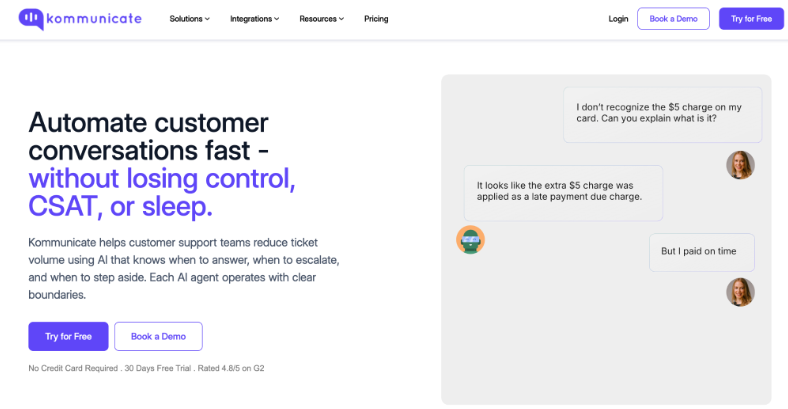
Kommunicate combines an AI chatbot, live chat and omnichannel inbox in one platform. Its AI agents handle customer support conversations across web, mobile, WhatsApp, Facebook Messenger and other channels, with full context preserved when a conversation moves to a human agent.
The agents can answer support queries, collect customer information, resolve tickets autonomously and escalate to live agents when a conversation requires human judgment. Kommunicate also connects to leading AI models including OpenAI, Anthropic and Google, so teams are not tied to a single provider.
Kommunicate positions the product around handoff quality: when an agent escalates a conversation, the support rep receives the full conversation history, customer details and any data collected by the bot. No context is lost in the transfer.
Key Kommunicate features
- AI agents for chat across web, mobile and messaging channels.
- Live chat with full bot-to-human handoff.
- Omnichannel inbox for WhatsApp, Facebook Messenger and more.
- Integration with OpenAI, Anthropic, Google and other AI providers.
- HIPAA, SOC 2 and ISO 27001 compliance.
- CRM and helpdesk integrations (Zendesk, Salesforce, Freshdesk and others).
- Custom bot flows and FAQ automation.
- Analytics and CSAT tracking.
Who should consider Kommunicate?
Kommunicate fits SMB and mid-market companies that want to automate a significant share of support volume without sacrificing conversation quality. It is well-suited to teams in regulated industries such as healthcare, insurance, and financial services, where compliance and data security are prerequisites.
It can be useful for support teams that need a reliable handoff layer: the bot handles routine queries at scale, and agents step in for complex or sensitive cases with full context already in front of them.
11. Amplitude
Best for: Product and growth teams that want AI agents working directly with behavioral analytics
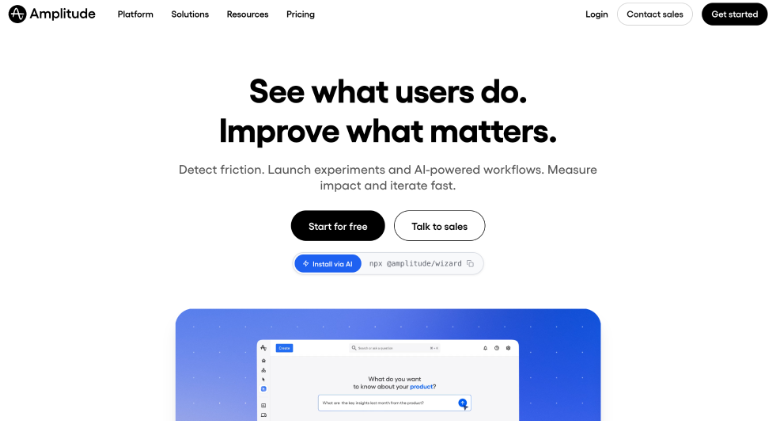
Amplitude is a digital analytics platform that has expanded into agent-native analytics. Its AI layer includes a Global Agent, specialized agents, custom agents, and MCP access, giving teams several ways to analyze product data without building every chart or investigation manually.
The Global Agent can answer data questions and create analytics artifacts, while specialized agents focus on recurring jobs such as dashboard monitoring, feedback synthesis, and session replay analysis. Custom Agents can be configured around specific workflows, data and questions, then run autonomously on a schedule.
Amplitude also connects its agents to external tools, allowing teams to combine behavioral data with context from systems used for planning, engineering and communication.
Key Amplitude features
- Global Agent for natural-language analytics
- Specialized agents for recurring analysis tasks
- Custom Agents that can run on schedules
- Behavioral analytics including funnels, retention and user journeys
- MCP access for external AI clients and workflows
- Agent connectors for cross-tool context and actions
- AI-assisted creation of charts, dashboards, cohorts and experiments
Who should consider Amplitude?
Amplitude is a strong fit for product, growth and analytics teams that want AI agents embedded in the way they investigate user behavior.
It is particularly useful when teams repeatedly ask the same analytical questions, monitor product changes or need insights to move directly into follow-up work across other tools.
12. Chatbase
Best for: Customer experience teams that need AI agents for support, sales, and product guidance across chat, email, and voice
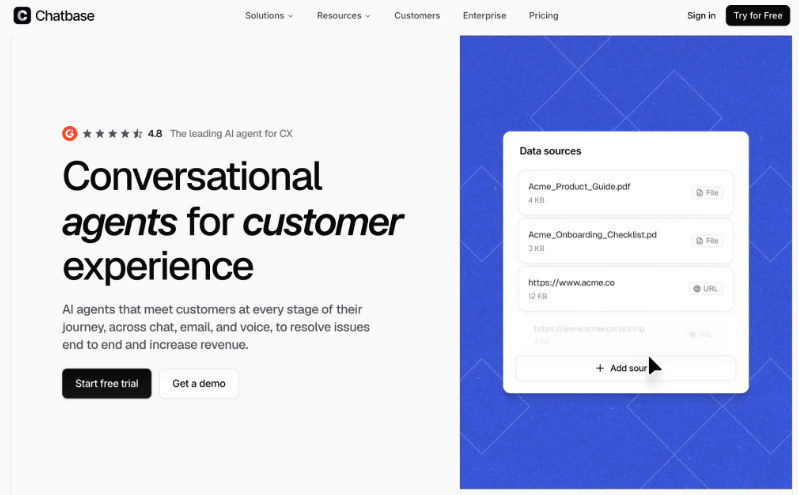
Chatbase is an AI customer experience platform used by over 10,000 businesses. Teams build agents to automate customer support. Anything from resetting passwords, processing tickets, troubleshooting issues, and resolving requests without human intervention. They collect and qualify leads, send data to your CRM or email list automatically, and handle e-commerce tasks like retrieving product details, checking stock availability, and assisting with purchases. Agents can also search the web in real time to surface up-to-date insights based on customer queries.
One of the best things about Chatbase is its simplicity. You don’t need to be a developer or have AI expertise to build powerful, actionable AI agents. It’s designed to be super intuitive, so you can dive right in, build, and deploy your agents without touching a single line of code. Whether you’re a business owner, marketer, or customer service manager, Chatbase gives you the tools to create the AI you need, with zero technical headaches.
If you're looking for a business-ready AI agent builder, Chatbase is one of the top options in 2026.
Key Chatbase features
- Three agent types: support, sales, and product guidance from one platform
- Actions that connect to Shopify, Stripe, Salesforce, Zendesk, Calendly, and custom APIs to resolve requests inside conversations
- Procedures for defining multi-step workflows in plain language, no code required
- Widgets: interactive visual components (product cards, booking calendars, order confirmations)
- Omnichannel deploy across chat, WhatsApp, email, Slack, Instagram, Messenger, and voice
- 30+ AI models across 7 providers with side-by-side comparison
- Built-in Helpdesk, Analytics, Testing, and Suggestions for continuous optimization
- SOC 2 Type II, HIPAA, GDPR. SSO, RBAC, audit logs, AES-256 encryption
Who should consider Chatbase?
Chatbase fits retail, e-commerce, SaaS, healthcare, and education businesses where customer conversations drive revenue and retention. It is built for teams that want one platform covering support, sales, and product guidance rather than separate tools for each.
The platform scales from a single founder to enterprise teams running thousands of conversations a day. Non-technical teams can build and launch an agent without engineering resources, and the agent is free to start with no credit card required.
13. livepro
Best for: Contact centers and enterprise support teams that need AI agents grounded in governed company knowledge
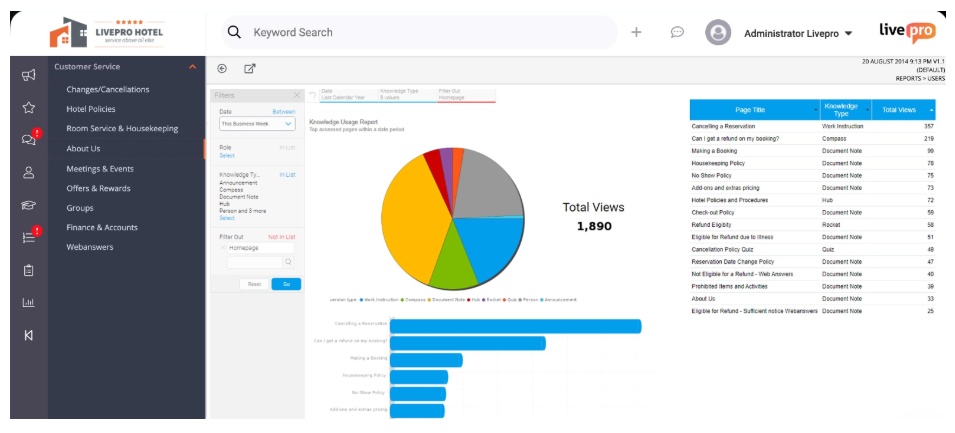
livepro is an AI-powered knowledge management platform built for contact centers and enterprise customer service teams. It centralizes policies, procedures, and operational knowledge so human agents and AI systems can work from the same controlled source of information.
Its AI capabilities include natural-language search, AI-generated answers and summaries, content authoring, and Luna, an AI voice agent that can handle routine customer calls using verified knowledge. For more complex processes, livepro also supports Work Instructions and branching decision guidance to help teams deliver consistent answers.
Governance is a major part of the platform. Teams can manage role-based permissions, approval workflows, version history, review reminders, and audit trails, which makes livepro particularly relevant where AI-generated answers need to stay aligned with approved information. Businesses assessing this category can also review livepro's guide to Stonly alternatives for knowledge management.
Key livepro features
- AI-assisted search and answers grounded in verified knowledge
- Luna AI voice agent for automated customer calls
- AI-assisted knowledge authoring and content import
- Work Instructions and branching decision guidance
- Role-based permissions, approvals, version control, and review workflows
- Knowledge analytics for searches, content usage, and knowledge gaps
- Integrations and API access for delivering knowledge across existing systems
Who should consider livepro?
livepro is best suited to contact centers and enterprise support teams that need AI to work from controlled, current company knowledge rather than an unmanaged collection of documents. It is especially relevant to organizations with complex processes, compliance requirements, or large knowledge libraries where inaccurate or outdated answers can create operational risk.
14. Monday.com
Best for: Operations and cross-functional teams that want AI agents working inside existing boards and workflows
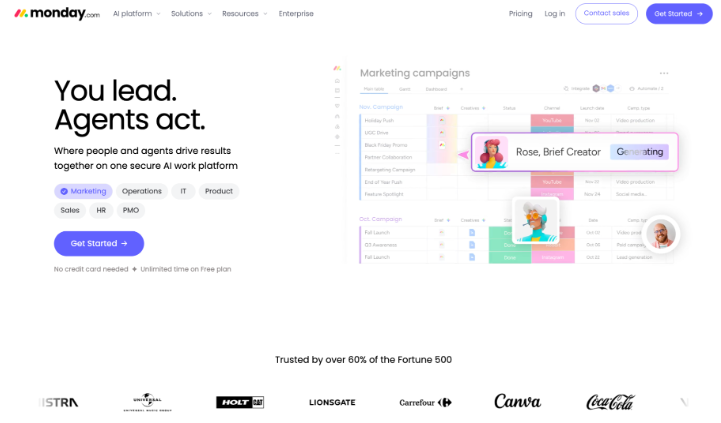
Monday.com is evolving its work management platform around people and AI agents working in the same operational environment. Its native agents can monitor activity, interpret context, make decisions within defined boundaries and execute tasks across boards and workflows.
Teams can use predefined expert agents or build custom agents for their own processes. Depending on permissions and connected tools, agents can create or update items, assign owners, change statuses, draft messages, log outcomes, and execute follow-ups.
The platform also supports external context and tools, including MCP-based connections, while keeping permissions and guardrails around what an agent is allowed to read or change.
Key Monday.com features
- Native AI agents inside monday.com workflows
- Custom AI agent builder
- Predefined expert agents for common business use cases
- Context from boards, docs, workflows and connected tools
- Actions such as creating items, assigning owners and updating statuses
- Read and write tools with configurable guardrails
- MCP connections and external integrations
- Activity history for reviewing what an agent did
Who should consider Monday.com?
Monday.com may suit operations, sales, project and cross-functional teams that already manage a meaningful part of their work inside the platform.
It is particularly relevant when a business wants agents to operate within existing workflows rather than introducing a completely separate AI interface employees have to manage.
As of July 2026, monday.com describes its native AI Agents feature as being in gradual release, so availability may depend on the account and product configuration.
How to Choose an AI Agent Solution
Start with a specific process rather than a broad goal to “use AI.” Identify where work currently slows down and what the agent would need permission to do.
For example, a customer service agent may need access to order data and escalation rules. A sales agent may need to collect lead details, update a CRM and book meetings. An analytics agent may need access to behavioral data, while an internal operations agent may require permission to update project records or trigger actions in other systems. In recruitment, an AI interview assistant may help candidates practice their responses and prepare for common interview scenarios.
Consider these questions before choosing a platform:
Can the agent complete actions?
Look beyond the quality of its written responses. Check whether the agent can update records, trigger workflows, make calls, create work items or complete transactions within the systems you already use.
The answer may also be that the agent itself should not perform every action. Specialist automation tools can sometimes handle a narrow task more reliably after the agent decides that task needs to happen.
Can people review and control it?
Businesses should be able to define boundaries, test behavior, and decide when an agent must involve a person. The platform should also provide enough visibility to investigate mistakes.
For higher-risk workflows, look closely at permissions, approved actions, escalation logic and activity history rather than relying only on a polished demo.
Does it work with your existing channels and systems?
A feature-rich tool may still be the wrong fit when it does not support your main customer channel, CRM, analytics stack or operational system.
Start with the systems the agent must read from and write to. Integrations are much more important when an agent is expected to take action rather than simply answer questions.
Does the agent have reliable context?
Agents often fail because they cannot find the right business information quickly enough, not because the language model cannot write a good response. In online retail, an ecommerce chatbot trains on the store's own product and policy pages, so a shopper gets an answer that matches what the site actually says.
Check how the platform handles knowledge sources, CRM records, permissions, data freshness and information spread across several tools. Many operations teams close this gap by pairing their agent stack with a bot-free AI note-taker that captures meeting context directly, feeding decisions and commitments back into the same systems the agents rely on. For complex internal agents, the data and context layer may matter as much as the model itself.
Can it represent your brand properly?
Customer-facing agents need clear language and design guidelines. Consistent presentation matters across the surrounding website, social pages and campaign materials.
Companies developing a new identity alongside their AI strategy can explore tools such as anAI logo generator or browse examples ofmarketing automation logos.
Which AI Agent Solution Is Best for Your Business?
The best AI agent solution for 2026 is the one suited to a defined business process.
SleekFlow and respond.io focus heavily on customer conversations. CloudTalk and 360 CTI bring AI into phone workflows. 360 SMS App connects AI-assisted messaging with CRM data, while Kommunicate and Chatbase focus on customer service automation.
Airbyte Agents solves a different problem by giving production agents access to a reliable business context. Amplitude brings agents into behavioral analytics, and monday.com puts them inside day-to-day work management. 360 InstantDocs is more specialized, automating document-heavy Salesforce workflows rather than acting as a general-purpose conversational agent.
Run a small pilot before expanding an agent’s responsibilities. Give it a measurable job, review how it handles exceptions and involve the employees who currently manage that process. A focused implementation will reveal more than a long feature checklist.
Written by DesignCrowd on Wednesday, July 29, 2026
DesignCrowd is an online marketplace providing logo, website, print and graphic design services by providing access to freelance graphic designers and design studios around the world.
